Understanding the Economics of Mortgage Refinancing
Refinancing a residential mortgage is one of the most effective financial maneuvers a homeowner can execute to reduce monthly overhead, eliminate private mortgage insurance (PMI), or convert home equity into capital for debt consolidation and property improvements. However, securing a lower interest rate is only one component of a successful refinancing strategy.
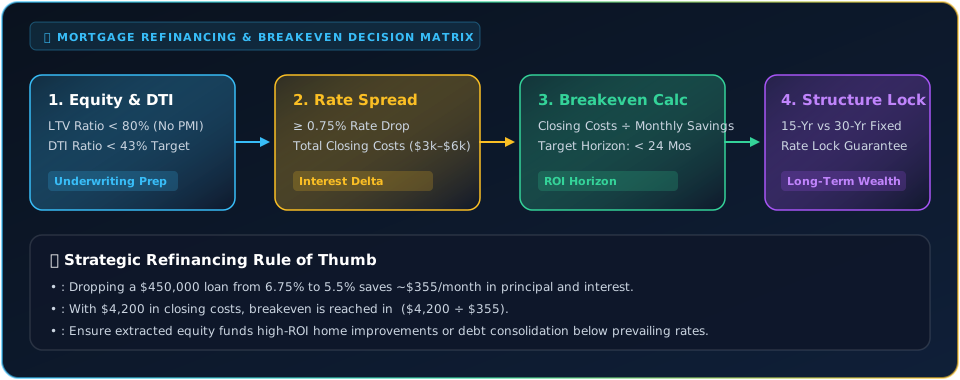
1. The Breakeven Horizon Formula
Refinancing incurs transactional closing costs (origination fees, appraisal fees, title insurance, and recording fees) typically ranging between 2% and 5% of the principal balance. The single most important financial metric is the Breakeven Horizon:
📐 Breakeven Formula:
$$ ext{Breakeven (Months)} = rac{ ext{Total Closing Costs}}{ ext{Monthly Principal & Interest Savings}}$$
Example: If refinancing a $400,000 mortgage from 6.875% to 5.5% saves $340 per month, and total out-of-pocket closing costs equal $4,080, your breakeven point is exactly 12 months ($4,080 ÷ $340). If you plan to remain in the property for longer than one year, the refinancing delivers positive return on investment.
2. Key Refinancing Structures
| Refinance Structure | Primary Objective | Ideal Candidate Profile |
|---|---|---|
| Rate-and-Term Refinance | Lower interest rate or adjust term (e.g. 30-year to 15-year). | Homeowners seeking lower monthly payments or faster principal payoff without withdrawing equity. |
| Cash-Out Refinance | Borrow against accumulated equity to receive cash at closing. | Homeowners consolidating high-interest debt (>18% APR credit cards) or funding high-value home remodels. |
| FHA / VA Streamline | Rapid, low-documentation rate reduction with no appraisal. | Borrowers holding active FHA or VA government-backed mortgages with clean 12-month payment histories. |
3. Underwriting Thresholds: LTV & DTI
Lenders evaluate applications against two core underwriting benchmarks:
- Loan-to-Value (LTV) Ratio: Calculated as $ ext{Loan Amount} div ext{Appraised Value}$. An LTV $le 80%$ eliminates private mortgage insurance (PMI), generating immediate additional monthly savings.
- Debt-to-Income (DTI) Ratio: Total monthly debt obligations (mortgage, auto loans, student debt, minimum credit card payments) divided by gross monthly income. Most conventional lenders require a DTI $le 43%$.
4. Step-by-Step Refinancing Roadmap
- Audit Credit Report: Ensure FICO scores are $ge 720$ to secure top-tier lender pricing and lower interest rate spreads.
- Gather Financial Documentation: Prepare the last 2 years of W-2s/tax returns, 2 months of bank statements, and recent mortgage statements.
- Compare Loan Estimates (LE): Solicit quotes from multiple lenders on Section A (origination charges) and Section B (services you cannot shop for).
- Lock Your Interest Rate: Secure a 30-to-45-day rate lock once target spread criteria are satisfied.